
Introduction: BMI for Imperial System Users
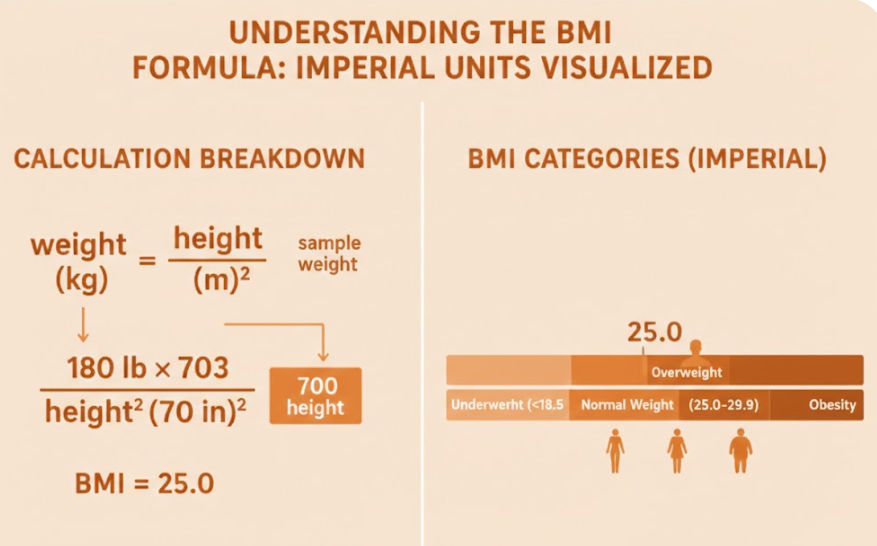
This comprehensive guide will help you understand how to calculate BMI using pounds and inches, interpret your results accurately, and take appropriate steps based on your BMI category—all without the hassle of converting to metric units.
Understanding the Imperial BMI Formula
The standard BMI formula uses metric units, but for imperial measurements (pounds and inches), we use this modified formula:
BMI = [weight (lb) ÷ height (in)²] × 703
The number 703 is the conversion factor that adjusts for the difference between metric and imperial units.
Example Calculation:
If you weigh 160 pounds and are 5 feet 7 inches tall:
- Convert height to inches: 5'7" = (5 × 12) + 7 = 67 inches
- Square the height: 67 × 67 = 4,489
- Divide weight by squared height: 160 ÷ 4,489 = 0.0356
- Multiply by 703: 0.0356 × 703 = 25.03
This result of 25.03 places you in the overweight category (25-29.9).
How Our Imperial BMI Calculator Works
Our BMI Calculator in Pounds and Inches simplifies this process:
- Select your height in feet and inches, or enter total inches
- Enter your weight in pounds
- Get instant BMI calculation with automatic category classification
- Receive personalized insights about your weight status
The calculator handles all the math, including the 703 conversion factor, so you get accurate results without manual calculations.
Imperial vs. Metric: Which System is More Accurate?
Both systems produce identical BMI results when calculated correctly. The choice depends entirely on your preference and familiarity:
Advantages of Imperial BMI Calculator:
- Familiarity: Most Americans naturally think in pounds and feet/inches
- No Conversions: Eliminates mental math or lookup tables
- Direct Input: Enter measurements as you normally record them
- Local Relevance: Aligns with how healthcare providers in imperial-using countries typically record measurements
For those who prefer metric measurements, we also offer our popular BMI Calculator for Adults in kg and cm which uses the standard metric formula.
Understanding Your BMI Results (Imperial)
Your BMI result falls into one of these categories, regardless of the measurement system:
- Underweight: Less than 18.5
- Normal Weight: 18.5–24.9
- Overweight: 25–29.9
- Obesity Class I: 30–34.9
- Obesity Class II: 35–39.9
- Obesity Class III: 40 and above
To see how your weight compares at different heights, check our BMI Chart in kg and lbs which provides dual-unit reference tables.
Special Considerations for Imperial System Users
Height Precision:
Unlike the metric system where height is typically recorded in centimeters (e.g., 175 cm), imperial height often includes both feet and inches. Our calculator accepts:
- Feet and inches separately (e.g., 5'9")
- Total inches only (e.g., 69 inches)
- Decimal feet (e.g., 5.75 feet)
Weight Precision:
The calculator accepts:
- Whole pounds (e.g., 150 lbs)
- Pounds with decimals (e.g., 150.5 lbs)
- Does not convert stones (use our BMI Calculator With Metric and Imperial Units for stone conversions)
Common Imperial BMI Questions Answered
Q: I know my weight in stones. Can I use this calculator?
A: This calculator requires pounds. If you know your weight in stones, multiply by 14 to convert to pounds first. For example, 10 stones = 140 pounds. For a calculator that accepts stones directly, try our BMI Calculator With Metric and Imperial Units.
Q: Is BMI interpretation different for imperial vs. metric users?
A: No, the BMI categories are identical worldwide. A BMI of 25 means overweight regardless of whether you calculated with pounds/inches or kg/cm.
Q: Why does the formula include 703?
A: The number 703 converts the units. Without it, the formula (weight/height²) would give incorrect results because pounds and inches don't align with the original metric formula's proportions.
Q: I'm 6'2" and 200 pounds. Is that healthy?
A: Without calculation: 6'2" = 74 inches. BMI = (200 ÷ 74²) × 703 = (200 ÷ 5,476) × 703 = 25.7, which is overweight. For personalized analysis, use our calculator above.
Q: Can children use this calculator?
A: This calculator uses adult BMI categories. For children and teens, use our specialized BMI Calculator for Children by Age and Gender which accounts for growth charts and percentiles.
Beyond BMI: Additional Health Assessments
While BMI provides a useful snapshot, consider these complementary assessments:
1. Waist Circumference:
Measure around your natural waist (just above hip bones). For adults:
- Men: Risk increases at >40 inches (102 cm)
- Women: Risk increases at >35 inches (88 cm)
2. Waist-to-Height Ratio:
Divide waist circumference by height. Ideally, keep this ratio below 0.5. Use our Waist to Height Ratio Calculator Guide for precise calculation.
3. Body Composition:
For athletes or muscular individuals, BMI may overestimate fat. Consider our Body Fat Percentage Calculator Explained for a more nuanced view.
Next Steps Based on Your BMI
If Your BMI is Normal (18.5-24.9):
Maintain your healthy weight with our practical How to Maintain a Healthy BMI guide. Regular monitoring with our BMI Calculator for Daily Monitoring can help you stay on track.
If Your BMI Suggests Overweight/Obesity (25+):
Understand the health implications with Obesity Explained Simply and explore sustainable approaches with our Weight Loss Calculator Explained.
If Your BMI Indicates Underweight (<18.5):
Learn about potential risks with Underweight Health Risks Explained and healthy weight gain strategies with Weight Gain Calculator Explained.
Limitations of BMI for Imperial System Users
The same limitations apply regardless of measurement system:
- Muscle Mass: May categorize muscular individuals as overweight
- Age Considerations: Doesn't account for natural muscle loss with aging
- Body Frame: Doesn't differentiate between small, medium, or large frames
- Fat Distribution: Doesn't indicate visceral (abdominal) fat
For age-specific considerations, explore our BMI Calculator for Adults Over 40.
Tips for Accurate Measurement
For Height:
- Measure without shoes on a hard surface
- Stand straight with heels together
- Use a wall-mounted measure if possible
- Record to the nearest 0.5 inch
For Weight:
- Use the same scale consistently
- Weigh at the same time of day (morning is best)
- Wear similar clothing each time
- Place scale on hard, flat surface
Conclusion
Our BMI Calculator in Pounds and Inches provides imperial system users with an accurate, convenient tool for weight status assessment. Remember that BMI is one indicator among many—not a complete health diagnosis.
Whether you're tracking progress, setting health goals, or simply curious about your weight classification, this tool offers valuable insights without mathematical complexity.
Ready to calculate your BMI? Enter your height in feet/inches and weight in pounds above for instant results. Save this page for regular check-ins, and explore our BMI Calculator With Health Interpretation for detailed analysis of what your BMI means for your health.
Interactive BMI Calculator (Pounds & Inches)
(Functional calculator implementation for imperial measurements)